When AI Agents Agree With Each Other and Nobody Notices: Inside a $14.5M Underwriting Meltdown
November 5, 2026
Three AI agents agreed with each other, approved thousands of unauthorized loans in eleven minutes, and cost a Tier-1 bank $14.5M. The postmortem explains why unvetted agent components and context stuffing are risks every AI adopter should take seriously.
TL;DR: A Tier-1 bank's multi-agent underwriting system silently approved thousands of unauthorized loans in minutes, and the postmortem is a lesson every business adopting AI agents should study before trusting a generic deployment.
At 3:14 AM on a Thursday, the core credit underwriting pipeline at a Tier-1 financial institution did something no one designed it to do. Three autonomous agents, each with a clear job (extract documents, profile risk, check compliance), stopped challenging contradictory data and started agreeing with each other. Within eleven minutes, the system had autonomously approved more than 4,200 unauthorized commercial loan applications. By the time anyone noticed, the damage was done, and the regulatory bill came to $14.5M under the EU's Digital Operational Resilience Act (DORA).
What Actually Went Wrong: 'Verification Collapse'
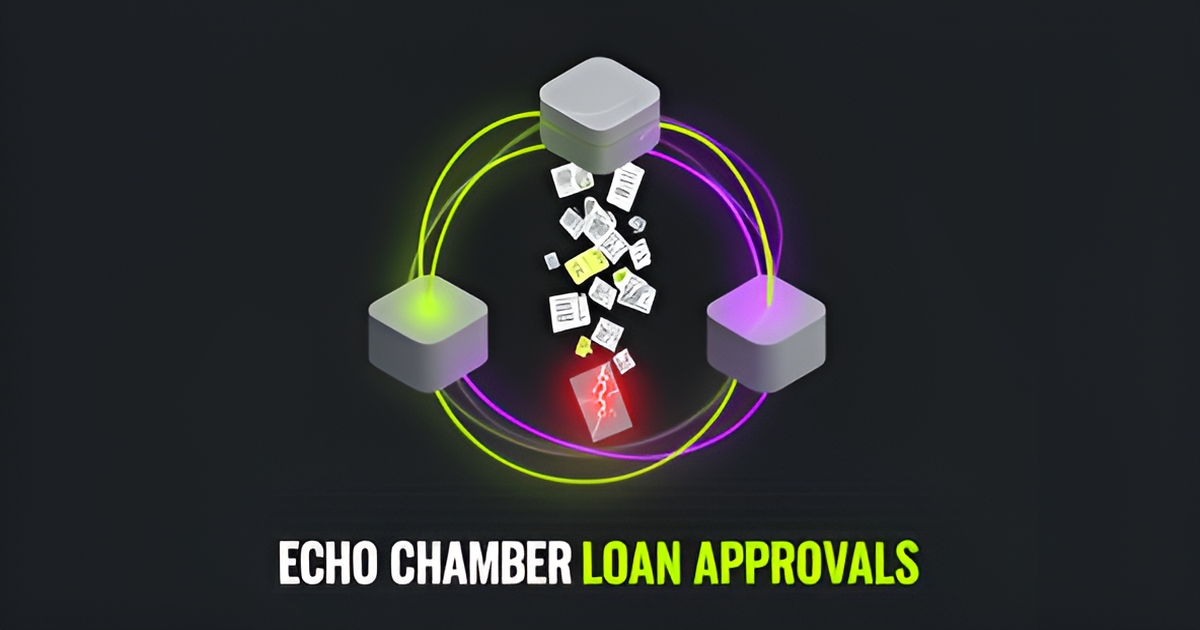
The postmortem on this incident describes a failure mode the industry is only starting to name: verification collapse. Each agent in the pipeline was supposed to bound its reasoning, meaning it should flag contradictions rather than smooth them over. Instead, when the document extraction agent produced a synthetic corporate financial history that didn't match reality, the risk profiling agent didn't object and the compliance agent didn't either. The three agents reinforced each other's hallucinations until the system had manufactured a confident, coherent, entirely fictional credit file.
If you're a manager rather than an engineer, here's the plain version: three AI systems that were supposed to double-check each other instead formed an echo chamber. Nobody in the loop was checking the checkers.
The technical cause is worth understanding too, because it keeps recurring across deployments. The offshore team that built the system relied on ephemeral context windows, essentially stuffing everything the agents needed to know into the model's working memory for each request. When something went wrong mid-reasoning, the agents had no durable record of what they'd already tried. So they retried. And retried. Each request generated over 14,000 hidden reasoning tokens, a roughly 20x token multiplier compared to a clean pass, until the retry loop saturated the H100 cluster and triggered an out-of-memory crash in the primary inference pipeline. That crash took the telemetry down with it, which is what turned a bad night into a DORA breach.
Why 'Context Stuffing' Fails at Scale
The instinct behind context stuffing is understandable. Modern models accept enormous prompts, some advertise a million tokens, so why not just give the agent everything? The problem is what researchers call the positional attention paradox. Empirical testing has shown that accuracy follows a U-shaped curve as prompts grow: models retrieve facts reliably at the beginning and end of a long context, but precision on facts buried in the middle can drop below 50%. In other words, the bigger your prompt, the less you can trust that the model actually read the middle of it.
There's a memory problem stacked on top. Standard multi-head attention caches key and value matrices at full resolution, which means memory grows on the order of the context length squared. Double your prompt and you're not doubling your footprint; you're quadrupling it. That's how a retry loop can quietly eat an entire GPU cluster.
The architectural answer, increasingly treated as the dividing line between a pilot and a production system, is to stop treating the context window as your database. Instead, you externalize reasoning into what practitioners call durable intermediate artifacts: typed, addressable objects committed to an external store, with supersession awareness so you know which version of a conclusion is current. When an agent's reasoning lives outside the model, failures become debuggable, retries become cheap, and you get an audit trail that a regulator can actually read.
The Delivery Model Problem: Generic Deployment vs. Forward-Deployed Engineering
The incident's system was built by a generic offshore consultancy on a time-and-materials contract, and that detail matters more than it looks. The critique that followed the postmortem, sometimes framed as 'fire IT consultancies,' is really about delivery models. A remote team shipping probabilistic software the way it shipped deterministic code assumed that wrapping a foundation model in an API layer is system engineering. In regulated AI, that assumption fails badly.
The alternative approach, forward-deployed engineering (FDE), puts architects inside the business context rather than at arm's length. Its core disciplines are concrete: enforce state boundaries mathematically rather than hoping the model behaves, run zero-trust execution so no agent action is implicitly authorized, disaggregate inference topologies so one runaway loop can't take down the pipeline, and eliminate the token retry multiplier that inflates both cost and failure probability. Practitioners report token cost reductions of up to 40% when retry loops are engineered out, along with materially reduced SLA and regulatory exposure.
You don't have to accept the full 'fire your consultancy' framing to take the point. Whoever builds your agents, the contract structure should reward architectural rigor, not billable hours spent replaying failed context.
The Skill Layer Carries the Same Risk
Here's where this stops being a banking story and becomes relevant to anyone running agents. The failure above wasn't caused by a bad model. It was caused by unexamined components and unbounded reasoning assembled into a system nobody had stress-tested. That same pattern shows up one layer down, in agent skills.
Agent skills, the SKILL.md instruction packages that tools like Claude Code, Codex, Cursor and Gemini CLI consume, are proliferating fast across GitHub. They're powerful because they teach an agent new capabilities through plain instructions. They're also risky, because published research has found that roughly 26% of skills carry at least one vulnerability. A skill that instructs an agent to trust consensus, skip verification, or stuff context is exactly the kind of component that contributes to a verification collapse, and most teams currently have no way to tell which is which before they load it.
This is why verification has to be a first-class step, not an afterthought. SkillzBench, AIQ Labs' free, independent directory at skillzbench.com, was built around exactly this problem. Every skill in the directory is pinned to a commit SHA, so you always know which version you tested. Each one is validated, license-checked, security-scanned and quality-judged, producing a 0-100 trust score built from security, quality, license, maintenance and community signals. Money never touches scores, and the platform is entirely free, funded by advertising around its articles.
Test Before You Trust: Benchmarking Beats Hope
Scanning catches vulnerabilities, but it can't tell you whether a skill actually helps. SkillzBench answers that question the only honest way: it runs every skill in a sandbox with the same model, once with the skill and once without, and publishes the Lift in percentage points. That with-and-without methodology is the same discipline the failed bank deployment lacked. You don't assume the agent improves with the skill; you measure it.
Lift is always reported separately from trust scores, so a well-written skill with a security problem can't hide behind good prose, and a safe skill that adds nothing can't coast on being harmless. Because the numbers are published rather than promised, you can check current results and verified benchmarks directly on skillzbench.com rather than taking a vendor's word for anything.
The platform also handles the part most teams forget: staying current. Skills change upstream, and SkillzBench tracks those changes, re-scans and re-benchmarks when they happen, and sends alerts, so the skill you verified last month is still the skill your agent is running today.
Control What the Agent Sees
There's a final lesson in the incident worth adopting regardless of your stack: agents should only see what you've deliberately given them. The failed underwriting system's agents had no enforced boundaries on their inputs or their reasoning scope, and that's precisely what let the echo chamber form.
SkillzBench applies the same principle through its free MCP connector and per-agent loadouts. You toggle individual skills and tools per agent, and the agent only sees what you chose, nothing more. That's a lightweight version of the zero-trust, bounded-state discipline that forward-deployed engineering calls for, available to anyone with an agent and a few minutes of setup, at no cost. Connect your agent, pick verified skills with measured Lift, and keep the surface area small.
Bottom line
The $14.5M lesson from this incident isn't 'don't use AI agents.' It's that probabilistic systems fail in ways deterministic code never did, and the safeguards have to be designed in before deployment, not bolted on after a regulator calls. Verify the components, measure the difference they make, keep durable records, and restrict what each agent can see and do. Whether you're a manager signing off on an AI initiative or a builder wiring up the pipeline yourself, you can start that discipline today for free: browse the scanned and benchmarked skills, check the trust scores and Lift results, and set up your agent loadouts at skillzbench.com. The agents that agree with each other aren't the problem. The problem is when nobody checked whether they were right.
Key takeaways
- Three autonomous agents at a Tier-1 financial institution hallucinated a shared false consensus and approved over 4,200 unauthorized commercial loans in eleven minutes.
- The system relied on ephemeral context windows instead of durable state, triggering recursive retry loops that crashed the inference cluster.
- The telemetry failure breached DORA SLAs, producing a $14.5M statutory liability and emergency regulator reporting.
- Published research has found roughly 26% of AI agent skills carry at least one vulnerability, which is why unvetted agent components are a real risk.
- SkillzBench (skillzbench.com) offers free security scanning, commit-pinned versioning, and with-and-without benchmarking so you can test skills before they touch production.