The Agent Protocol Stack, Explained: MCP, A2A, and WebMCP Are Now Running Real Businesses
November 7, 2026
Uber runs 800+ MCP servers, Adobe put its agent in ChatGPT and Claude, and agentic checkout is processing live payments. Here's how the MCP, A2A, and WebMCP layers fit together, and how to keep your agents' credentials and skills under control.
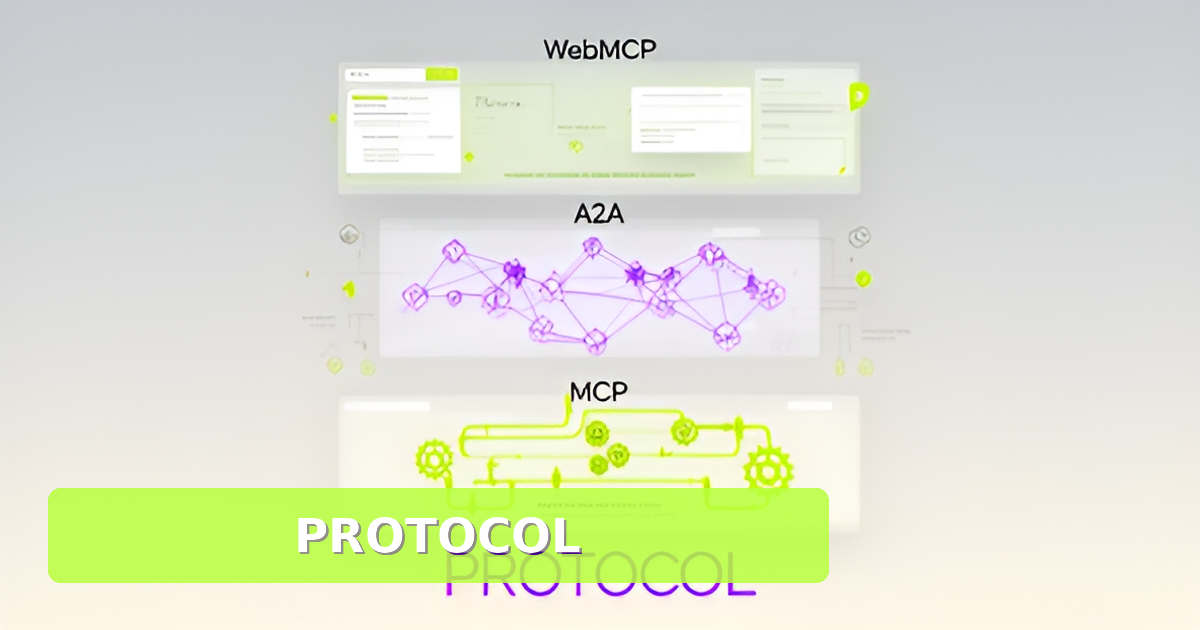
TL;DR: MCP has become the default way AI agents connect to tools, A2A v1.0 now standardizes agent-to-agent communication, and WebMCP is bringing agents to live websites, so this piece maps the stack in plain English and shows how to keep your agents' credentials and skills under control.
Two years after Anthropic released the Model Context Protocol as an open standard, the plumbing of the agent economy has stopped being theoretical. Uber says it now runs more than 800 MCP servers and 5,000 tools internally. Adobe pushed its marketing agent into ChatGPT, Claude, Copilot, and Gemini this week with prebuilt MCP connectors. Cashfree's agentic checkout started processing live transactions on November 6. And the A2A protocol, which lets agents talk to each other, hit version 1.0 this month. If you're adopting AI at work, you'll soon be asked which of these layers your tools use and, more importantly, what your agents are allowed to do through them. Here's a plain-English map of the stack, and where the risks actually sit.
The Three Layers, in Plain English
Start with the layer you'll hear about most: MCP, the Model Context Protocol. It connects one agent to its tools and data sources. Think of it as the socket your AI assistant plugs into so it can query a database, call an API, or read a file. It uses a client-host-server architecture over JSON-RPC, and remote MCP servers now follow a defined OAuth 2.1 profile, which is good news for anyone who has to sign off on the security review.
The second layer is A2A, the Agent2Agent protocol, which reached v1.0 in November 2026. Where MCP connects an agent to its tools, A2A connects agents to each other. It handles discovery, task delegation, and progress tracking between agents built by different teams or vendors, treating each agent as a black box with a published Agent Card. One practical warning: tutorials written in 2025 may describe 0.x semantics that no longer work, because v1.0 includes breaking changes.
The third layer is the newest. WebMCP lets websites expose actions directly to browser-based agents. Cashfree's Checkout for Agents is the first high-profile consumer use: registered tools let an agent read order details, list payment methods, and generate QR codes, while the customer always approves and authenticates the payment. If you run an e-commerce business, this is the layer to watch.
A quick mental model: MCP is agent-to-tool, A2A is agent-to-agent, WebMCP is website-to-agent. Most real deployments will end up using more than one.
Enterprises Are Already Running This at Scale
Uber's internal platform is the clearest signal of where things are heading. After team-by-team integrations produced duplicated infrastructure and inconsistent security, Uber built a centralized MCP Gateway with two parts: a registry that acts as the single source of truth for which tools exist and who owns them, and a proxy gateway that translates MCP calls into internal protocols. An automated crawler scans Uber's interface definitions and registers new tools, though new tools stay disabled by default until someone approves them.
That last detail matters more than it sounds. Default-off is a governance decision, and it's the same instinct behind SAP's open question about agentic workflows: should an agent that can check an invoice also be able to approve it? The answer at most companies should be no, at least until you've thought carefully about it.
Adobe's move shows the pattern spreading to marketing teams. CX Enterprise Coworker now operates inside ChatGPT, Claude, Microsoft Copilot, Gemini, and Databricks Genie, with prebuilt connectors to Amazon Ads, Meta ads, Snowflake Cortex, and others. The open question Adobe hasn't answered: do your data permissions, approval checkpoints, and audit trails still hold when the interface lives outside Adobe's walls? That's a question to ask any vendor before you connect an agent to your systems.
Security Is the Bottleneck, and Everyone Knows It
The same week Cashfree went live, security company Edera launched Object Capability Bounded Authority, a hypervisor-enforced model that separates what an agent is allowed to do from the credentials it needs to do it. The problem it targets is familiar: today, agents often get static secrets injected into their containers, and a compromised agent can exfiltrate them. Edera's approach gives an agent a narrowly scoped capability instead, so a coding assistant can modify one GitHub repo without ever holding your personal access token.
This matters for skills, too. Agent skills, the SKILL.md instruction packages that extend tools like Claude Code, Cursor, and Codex, are spreading fast, but published research found that roughly 26% of them carry at least one vulnerability. A skill is instructions your agent will follow, which means a malicious or sloppy skill is a direct line into your agent's behavior. The supply-chain problem that package registries eventually solved for code is now arriving for skills, mostly unvetted.
Vendors are reacting in their own ways. Cashfree designed its checkout tools as read-only. Uber keeps new tools disabled by default. Edera wants credentials out of agents entirely. The common thread is least privilege: give each agent exactly the access it needs, and nothing more.
What Small Teams Can Borrow From the Big Players
You don't need Uber's engineering budget to apply the same discipline. The principles translate directly:
First, keep a registry. Know which tools and skills each of your agents has access to, and who approved them. A spreadsheet beats nothing; a proper inventory beats a spreadsheet.
Second, default to off. When you connect a new tool or skill, enable it deliberately, per agent, rather than letting every agent see everything.
Third, pin your versions. Skills and tools change upstream, and a change you didn't review can change your agent's behavior. Version pinning turns silent drift into a reviewable event.
Fourth, test before you trust. If a skill claims to speed up a workflow, check that claim with the same model, with and without the skill, and look at the measured difference rather than the marketing.
This is exactly the workflow SkillzBench was built for. The free directory continuously crawls and deduplicates skills from GitHub, pins every version to a commit SHA, runs security scans, license checks, and quality reviews, and publishes a trust score from zero to one hundred. Every skill is benchmarked in a sandbox with the same model, with and without the skill, and the Lift is shown in percentage points, always separately from the rating. Then the free MCP connector and per-agent loadouts let you toggle exactly which skills and tools each agent sees, which is the small-team version of Uber's default-off registry. Everything on the platform, including the benchmarks and change alerts, is free.
Skills Are Becoming the New Shareable Artifact
One more trend worth your attention. At Foo Camp, Tim O'Reilly argued that software's primary artifact may be shifting from code to natural-language prompts, generation processes, and developer skills. Meanwhile, Vercel's agent-browser, a Rust CLI with roughly 46,000 GitHub stars, now ships its agent skill bundled with the binary to reduce version drift, and the Playwright MCP README itself observes that coding agents increasingly prefer CLI-based workflows exposed as skills over MCP tool calls, mainly for token efficiency.
Read those together and a picture emerges: the skill file is becoming the unit of shareable agent capability, the way libraries and packages were for code. That's genuinely useful, because good skills encode hard-won patterns instead of making every developer regenerate them from scratch. It also raises the stakes on vetting. Code got package registries, scanners, and audits over decades. Skills need equivalents now, while the ecosystem is still young enough to set norms.
Bottom line
The protocol stack is settling: MCP for tools, A2A for agent-to-agent, WebMCP for websites, with skills emerging as the shareable capability layer on top. The companies doing this well share one habit: they treat agent authority as something to be granted deliberately, scoped tightly, and reviewed regularly. You can adopt that habit today without building a gateway. Browse and verify skills for free at skillzbench.com, check the benchmarked Lift before you commit, and use the free MCP connector with per-agent loadouts so each agent sees only what you chose. The stack is ready. The governance part is up to you.
Key takeaways
- MCP connects an agent to its tools; A2A connects agents to each other; WebMCP lets websites expose actions to browser-based agents. Knowing which layer does what is now a practical business skill.
- Enterprise adoption is real: Uber reports 800+ MCP servers and 5,000+ tools behind a centralized gateway, and Adobe, SAP, and Cashfree all shipped MCP-based integrations in the past two weeks.
- Security is the emerging bottleneck. Edera's new capability-isolation launch exists because agents are over-credentialed, and published research found roughly 26% of agent skills carry at least one vulnerability.
- Vendors are converging on least-privilege design: Cashfree's agentic checkout tools are read-only, and SAP is openly debating whether an agent that can check an invoice should also approve it.
- You don't need Uber's budget to get the same discipline. SkillzBench's free directory scans and benchmarks agent skills, and its free MCP connector lets you scope exactly what each agent can see.