Shadow AI Breaches Have Doubled. Your Team's Next MCP Server Could Be the Cause.
October 24, 2026
Security incidents involving shadow AI more than doubled year-over-year, and Tenable warns the risk now includes unvetted MCP servers and agent skills. Here's a practical defense for teams that can't afford to slow down.
TL;DR: Security incidents involving shadow AI assets more than doubled in 2026, and unvetted MCP servers and agent skills are now among the biggest blind spots, so teams need a vetted path to AI capability rather than a blanket ban.
Somewhere in your company right now, an employee is connecting an AI assistant to something it probably shouldn't touch. Maybe it's a free MCP server downloaded from GitHub that bridges a desktop assistant to your customer database. Maybe it's a browser extension with quiet read access to your CRM. Nobody approved it. Nobody scanned it. It works, so it stays.
This is shadow AI in 2026, and it has outgrown the old definition. It used to mean someone pasting confidential text into a personal chatbot. Now, according to Tenable's Cybersecurity Awareness Month guidance, it covers local models, AI coding assistants, autonomous agents, MCP servers, APIs, browser extensions, and AI features embedded inside everyday software. The problem is no longer one chatty employee. It's an entire layer of unmanaged AI infrastructure.
And the cost of ignoring it is no longer theoretical. IBM's 2026 Cost of a Data Breach Report found that security incidents involving shadow AI assets more than doubled year-over-year, from 20% to 43% of breaches, with an average cost of $5.39 million. That's roughly $400,000 above the global average for a breach. If you're adopting AI at work (and your competitors certainly are), this is worth ten minutes of your attention.
Why the numbers got worse so fast
The doubling of shadow AI incidents isn't a coincidence. It tracks directly with how fast AI tooling has spread through organizations. The Cloud Security Alliance warned back in April 2026, in its report "The Invisible Enterprise," that AI adoption has dramatically outpaced governance. Most enterprises now run an uninventoried layer of AI infrastructure that sits outside policy, access control, and audit regimes.
Tenable's own telemetry backs this up. A 30-day analysis across 7,000 customer environments, using 274 AI-specific detection plugins, turned up 457 million security issues. That averages out to roughly 62,000 AI-related exposures per customer. Some of those are misconfigurations and stale credentials, but a meaningful share are tools employees installed without anyone's knowledge.
The human gap explains the rest. The U.K. government emphasized this in September 2026: employees adopt useful tools immediately, while approval processes and usage policies move at committee speed. When your best developer needs an AI coding assistant today and the approved-tools list is three weeks away, they'll take the shortcut. Punishing that behavior doesn't fix it. Understanding why it happens does.
The MCP server problem, specifically
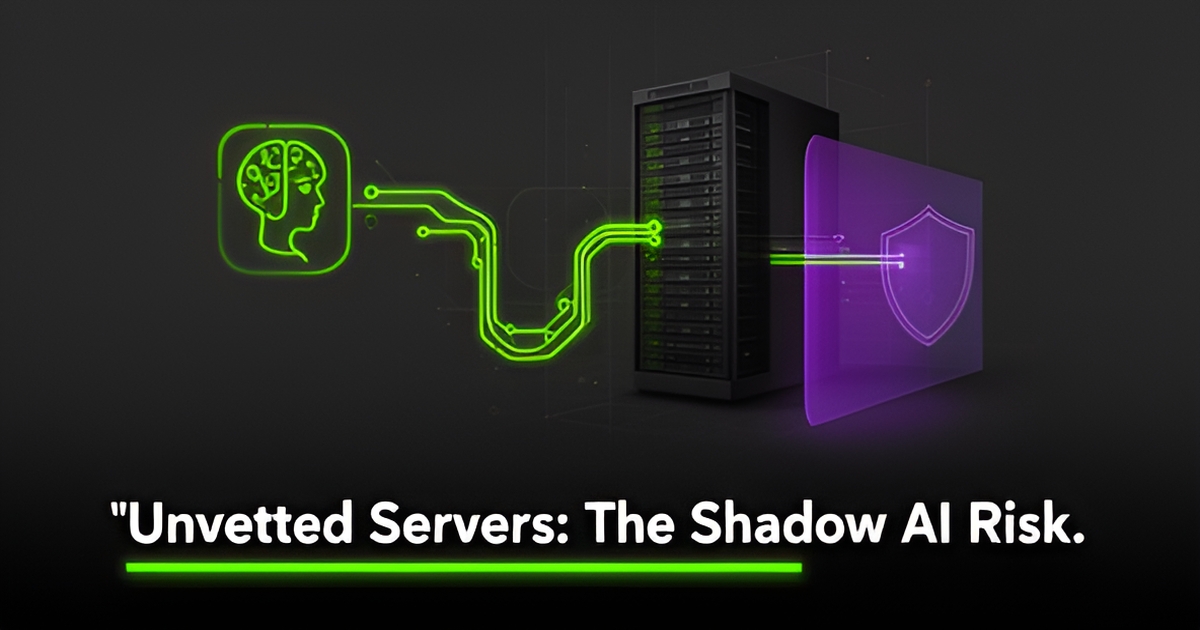
Here's the scenario that should make agent builders and IT managers pause. Tenable describes an employee installing an unvetted open-source MCP server to bridge a desktop assistant with an internal customer database. An MCP server is a connector: it's the piece that lets an AI agent actually reach tools and data. Which means whoever controls that server controls what the agent can see and do.
Install one from a random repository and you've effectively handed an unexamined piece of code a bridge to your internal systems. Pair it with broad admin credentials (another scenario Tenable flags) and the blast radius gets much larger. This isn't hypothetical fearmongering. MCP adoption has exploded precisely because it's easy, and easy is exactly what shadow AI thrives on.
The same logic applies to agent skills. These are instruction packages that shape how agents like Claude Code, Cursor, and Codex behave. Research published earlier found that around 26% of skills carry at least one vulnerability. Roughly one in four. If your team is pulling skills off GitHub the same way it pulls npm packages, that's a one-in-four chance any given install has a problem.
What a reasonable defense looks like
Tenable recommends three things, and they're sensible whether you run a five-person shop or a five-thousand-person enterprise.
First, awareness and education. Fold shadow AI into your security training, and talk to employees about why they reach for unsanctioned tools instead of just forbidding them. If the approved path is slow or nonexistent, people will route around it.
Second, governance. Write an AI acceptable use policy with a real approved-tools list. Not a list that says "AI is allowed." A list that names specific tools, specific connectors, and specific data boundaries.
Third, exposure management. Inventory what AI is actually running in your environment, enforce policy, control access, and audit regularly. Treat shadow AI like any other unmanaged attack surface, because that's what it is.
There's a fourth step I'd add for teams using agents: vet every skill and connector before it reaches an agent, and give each agent only the capabilities it needs. That's governance at the agent level, and it's easier to do than it sounds.
How to vet skills and connectors without slowing everyone down
The reason people skip vetting is that it's tedious. Pinning a version to a specific commit, checking the license, scanning for vulnerabilities, and actually testing whether the skill improves anything takes hours nobody has. So the shortcut wins.
This is the gap SkillzBench was built to close. It's a free, independent directory of agent skills that continuously crawls and dedupes skills from GitHub, then verifies each one: every version is pinned to a commit SHA, license-checked, security-scanned, and quality-judged before it appears. Each skill gets a trust score from 0 to 100 based on security, quality, license, maintenance, and community signals, and that score is kept strictly separate from performance results.
Performance is handled through benchmarking. Every skill is tested in a sandbox with the same model, with and without the skill, and the Lift in percentage points is published so you can see whether a skill actually helps before you install it. Ratings tell you it's safe; Lift tells you it's worth using. Money never touches either.
On the connector side, SkillzBench runs a free MCP server plus per-agent loadouts. You toggle the skills and tools each agent can access, and the agent only sees what you chose. That's the lightweight version of the approved-tools list Tenable recommends, applied at the agent level: employees get flexibility, agents get a curated boundary. And because SkillzBench tracks upstream changes, re-scans, and re-benchmarks when skills update, a skill that was clean last month doesn't stay trusted by default.
Everything on the platform is free, funded by ads around its blog content rather than by charging users or selling placement in scores. If you want to see current numbers and verified results, they're live at skillzbench.com.
Bottom line
Shadow AI isn't going away, and banning it won't work. IBM's numbers make the cost of pretending otherwise clear: incidents doubled, and the average breach now runs $5.39 million. The realistic move is to give your team a safe path that's faster than the unsafe one. That means an acceptable use policy people can actually follow, an approved-tools list with real names on it, and vetted skills and connectors instead of random GitHub installs. If your team is building with agents, browse and test the free, security-scanned skills and the free MCP connector on SkillzBench. It takes minutes, and it's a lot cheaper than a breach.
Key takeaways
- IBM's 2026 Cost of a Data Breach Report found incidents involving shadow AI assets jumped from 20% to 43% year-over-year, with an average breach cost of $5.39 million
- Tenable warns shadow AI now includes MCP servers, browser extensions, autonomous agents, and locally hosted models, not just chatbots
- One of Tenable's key risk scenarios is an employee installing an unvetted open-source MCP server that bridges an assistant to an internal customer database
- Published research found roughly 26% of agent skills carry at least one vulnerability
- Practical defenses include an AI acceptable use policy, an approved-tools list, and vetting every skill and MCP server before it reaches an agent