Anthropic's $107 Billion IPO, Agent-to-Agent Protocols, and Why Your AI Bill Keeps Growing Anyway
November 23, 2026
Anthropic's $107.3 billion IPO revived the AI trade, but the real story is underneath: agent protocols just standardized under one foundation, and token economics mean your AI bill grows even as prices fall.
TL;DR: Anthropic's record IPO caps a week when agents went mainstream: open protocols now let them talk to each other, token math says they'll cost you more even as prices fall, and the skills you bolt onto them decide whether the whole thing works.
If you needed proof that AI agents stopped being a developer curiosity and became the main event, this week delivered. Anthropic just priced the largest IPO on record, raising $107.3 billion at $83 a share and landing a fully diluted valuation around $1.5 trillion, with gray-market indications pointing 20% to 26% above the offer before its Nasdaq debut. The listing lifted Nasdaq futures about 2% and pulled the S&P 500 out of a five-day slump. But the more interesting story for anyone actually running agents is underneath the market noise. Two things happened in the background that will matter to your budget and your architecture long after the ticker settles: the two major open agent protocols finished consolidating under one neutral foundation, and the economics of running agents got a lot harder to ignore.
Two protocols, one foundation, and why the split matters
The agent stack now has a settled shape. MCP, which Anthropic open-sourced and donated to the Linux Foundation's Agentic AI Foundation in December 2025, handles the vertical layer: how one agent reads a schema, calls a tool, or reaches your data. A2A, which Google launched in April 2025 and handed to the Linux Foundation that June, handles the horizontal layer: how independently built agents discover each other, delegate work, and track state without exposing their internal prompts, memory, or models. In August 2026, A2A moved into the AAIF alongside MCP, putting both standards under one governance roof. A2A hit its stable v1.0 spec in March 2026 and now reports backing from more than 150 organizations, including AWS, Cisco, Microsoft, Salesforce, and SAP, with production use in supply chain and financial services.
The practical upshot is simple. Your agents will soon spend as much time talking to other agents as they spend talking to you. An A2A agent publishes a signed Agent Card describing its identity, skills, endpoints, and auth requirements. Clients create typed tasks that move through lifecycle states, including one called input-required, which is the hook that lets a human pause an autonomous interaction. That state matters more than it sounds, and we'll come back to it.
The handoff problem nobody priced in
Here's where networked agents get uncomfortable for anyone in sales or revenue operations. When a buyer-side agent negotiates with your vendor-side agent, nobody is watching the conversation in real time. A procurement agent can systematically probe your sales agent for discounts, extended payment terms, or bespoke SLAs, and an overly rigid sales agent can quietly let a high-value deal die in a failed state with no human ever seeing it. The financial exposure isn't hypothetical; it's structural.
The right fix isn't a smarter prompt. It's a deterministic policy layer that decides when an agent must escalate, with the input-required task state acting as the pause button and event-driven routing pushing edge cases to a human deal desk. The LLM should execute the negotiation; a rule engine should decide when the negotiation stops. If you're wiring agents together with MCP for tools and A2A for collaboration, plan the escalation policy before you plan the workflow.
The same discipline applies one layer down, at the skills your agents load. Every skill you attach to an agent changes what it can reach and how it behaves, and published research has found that roughly 26% of skills carry at least one vulnerability. SkillzBench, which is free, pins every skill in its directory to a commit SHA, security-scans it, license-checks it, and benchmarks it in a sandbox with and without the skill installed, so you can see the measured Lift before you deploy anything. Its free MCP connector also lets you toggle skills and tools per agent, so an agent only ever sees what you explicitly chose for it. That's the per-agent loadout discipline the A2A world assumes you already have.
Tokenomics: cheaper tokens, bigger invoices
The second background story is the strange arithmetic of AI spending. Since 2023, per-token prices have fallen more than 90% according to the Silicon Data Token Expenditure Index. Epoch AI estimates the cost of a fixed level of capability declines roughly 47% per quarter, and MIT puts frontier benchmark performance improvements at 5x to 10x per year. By any normal logic, AI bills should be collapsing.
They aren't. Bain found that between December 2024 and December 2025, token costs halved while token consumption grew about 450%, netting roughly 2.75x higher spend. This is the Jevons paradox, the same dynamic that made more efficient steam engines increase Britain's coal consumption in 1865. Apollo's Torsten Slok has applied it directly to AI: cheaper tokens mean firms run more agents and automate more workflows, not fewer. The equation that governs your budget is AI spend equals price per token times tokens per task times tasks, and vendors are pushing down the first term while adoption explodes the other two.
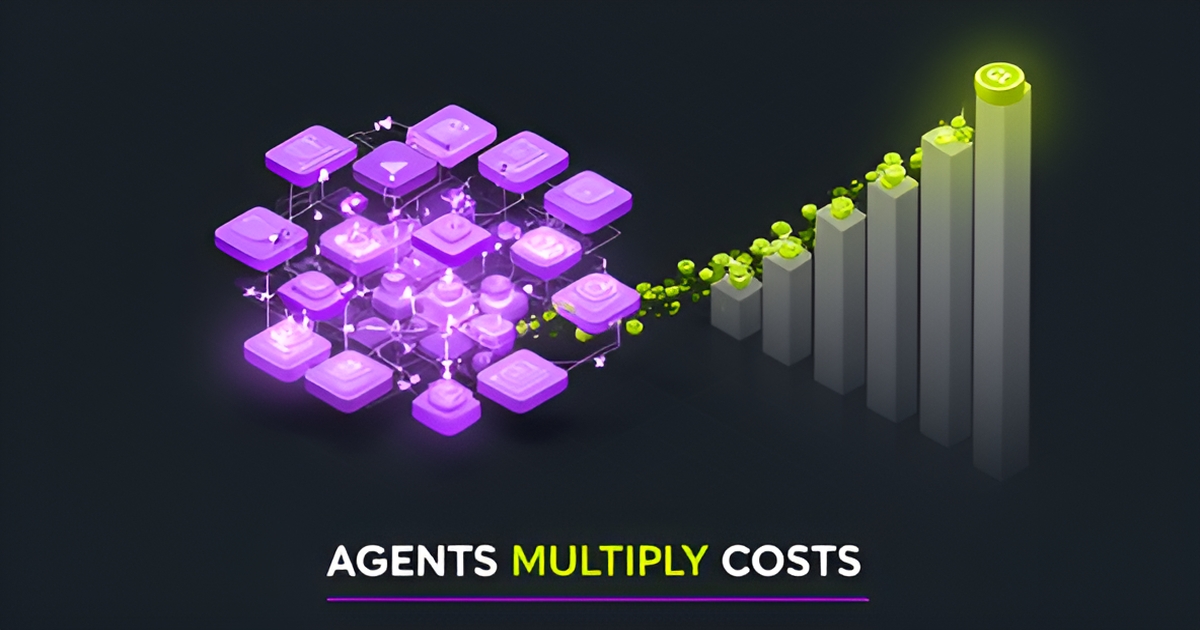
Agents are the multiplier. Anthropic has reported that agents consume roughly 4x the tokens of chat, and multi-agent systems around 15x. Google said at I/O 2026 that it processes 3.2 quadrillion tokens a month, up from 9.7 trillion two years earlier, and its model APIs now push nearly 32 billion tokens per minute, more than 4x year over year. Meanwhile flat-rate pricing is visibly breaking: Anthropic introduced weekly limits for Claude Code in 2025, and Bloomberg reported Uber capped AI spending at $1,500 per employee per month after Fortune revealed the company burned its full-year AI budget in four months. There's a wrinkle, too: MIT estimates the cost of running frontier models is actually rising 3x to 18x per year as models grow and reasoning demands climb. Cheaper AI and more expensive AI are both true; they just describe different numbers.
The practical controls are unglamorous and effective. Forecast volume rather than price. Set budgets per agent and per employee. Route tasks by difficulty, use caching, tune reasoning effort, cap agent loops, and attribute costs so you know which workflow is eating the budget. And since skills directly affect tokens per task, measured Lift data matters: a skill that genuinely improves task completion changes your cost per outcome, and you can test that for free on SkillzBench before committing compute to it.
The market read: what the IPO tells you about where this goes
The Anthropic listing is the headline event, but the session's other moves tell the adoption story. Palo Alto Networks jumped about 10% on a guidance raise and a $4.5 billion acquisition of Applied Compute at roughly 45x ARR, a deal explicitly aimed at running cyber-specific AI models. CrowdStrike, Cloudflare, and Zscaler moved higher with it. The message from the market is that infrastructure for securing and running AI workloads is being priced as a growth business, not a defensive one. Macro conditions, a 10-year yield near 5.085% with December Fed hikes priced in after hawkish FOMC minutes, barely dented the AI bid. Traders treated geopolitical noise as background.
Bottom line
Put the three threads together and a picture forms. The protocols have standardized, so agents will interoperate across company lines whether you're ready or not. The token math says adoption, not price, drives your spend, so the organizations that govern demand will control their costs while everyone else watches invoices climb. And the IPO market is funding all of it at valuations that assume agents become default infrastructure. Your preparation is boringly concrete: an escalation policy for agent-to-agent interactions, per-agent budget caps, cost attribution, and a disciplined approach to what you bolt onto your agents in the first place. That last part you can start today, free, by browsing the scanned and benchmarked skills directory and grabbing the MCP connector at skillzbench.com.
Key takeaways
- Anthropic raised $107.3 billion at $83 a share, a roughly $1.5 trillion valuation, reviving the broader AI trade on the Nasdaq
- The two big open agent standards, MCP and A2A, now live together under the Linux Foundation's Agentic AI Foundation, with backing from more than 150 organizations
- Token prices have dropped more than 90% since 2023, yet total AI spend keeps climbing: Bain found token costs halved while consumption grew about 450% in one year
- Agents consume roughly 4x the tokens of chat, and multi-agent systems around 15x, which is breaking flat-rate and per-seat pricing
- Autonomous agents negotiating across company lines need deterministic escalation rules, and every skill you attach to an agent changes both its cost and its risk profile