Agents Can Now Rent GPUs On Their Own. Who Decides If They Should?
November 12, 2026
Runpod handed agents the keys to cloud GPUs this week. A same-day gate test showed why that's riskier than it sounds, and what to do about it.
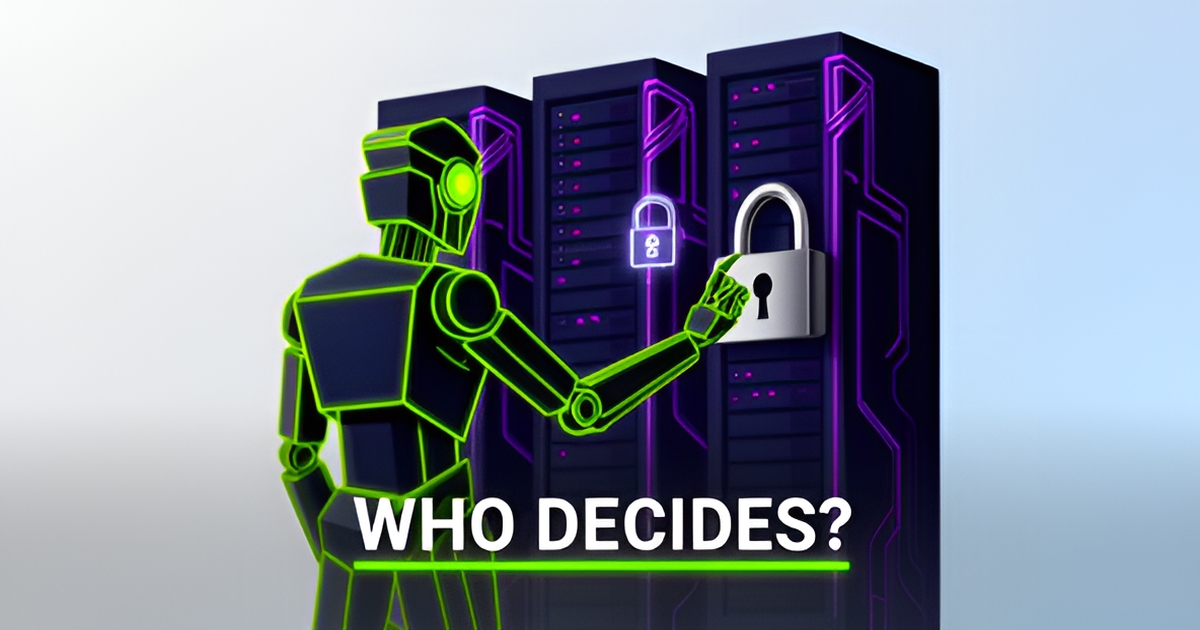
TL;DR: Runpod's new agent platform lets AI assistants provision cloud GPUs, but a live gate test shows the safeguards stop accidents without judging spend, and that gap is the next frontier in agent safety.
This week, AI agents got something they've never had before: the ability to rent industrial GPU hardware on their own. On November 10, Runpod announced 'Runpod for Agents,' an expansion of its MCP server that lets assistants like Claude Code, Codex, Cursor, and ChatGPT select hardware, deploy Pods and serverless endpoints, and diagnose failures without a human ever opening a console. One customer, Open Source Films, claims roughly 10x production throughput from agents provisioning compute on demand. That's a vendor-reported number, so treat it accordingly, but the direction is clear. The interesting part of the story isn't the capability. It's the question nobody in the announcement answered: when an agent can spend your money, who decides whether it should?
What Runpod for Agents Actually Does
The expansion ships a hosted MCP server plus a library of 35 tested skills: 10 core skills covering hardware selection, Pod operations, and serverless endpoint management, and 25 specialized skills for use cases like troubleshooting, cost audits, and endpoint operations. If you've used MCP before, the pattern is familiar. Your agent connects to your Runpod account and can act on it directly. Runpod's safety model is built on categorization. Tools are labeled read-only or destructive. Read-only operations, like browsing GPU availability or running a cost audit, can auto-execute in compatible clients. Destructive operations, like deleting a Pod, require explicit developer confirmation. It's a sensible baseline. It prevents the obvious accident where an agent deletes your infrastructure because it misread an instruction.
The Gap: Safe Isn't the Same as Smart
Here's the problem a live gate test published the same day by ScriptMasterLabs made hard to ignore. Runpod's system answers 'may the agent do this?' It never answers 'should the agent do this?' An idle H100 bills at the same hourly rate as a busy one. If an agent decides to rent high-end hardware for a task that doesn't need it, the categorization model has nothing to say. The tool wasn't destructive. The confirmation prompt never fired. The money just left. ScriptMasterLabs tested this directly. In its test environment, browsing and cost-audit actions auto-acted as expected, scoring 0.9545. But deploying a single H100 Pod, a spend action that shouldn't have passed without scrutiny, auto-acted at 0.8571. Ordinary infrastructure vocabulary was enough for a keyword heuristic to wave a real purchase through. ScriptMasterLabs called it a gate failure, and the label fits.
A Paid Layer for Judgment
ScriptMasterLabs' answer is the Verdict Protocol, a decision layer priced at $0.25 USDC per decision (and $0.01 per seal) that sits between an agent's request and the actual spend. It works by freezing the proposed action into a 'decision capsule,' then having a jury of voters evaluate it against a constitution before any money moves. The result is a tamper-evident seal recording approval or refusal. There's no subscription; you pay per challenge. Whether the jury mechanism is the right architecture is an open question, and $0.25 per decision adds up fast for a busy agent. But the underlying insight is sound. As agents get more autonomy over budgets, the valuable product stops being the harness and starts being the judgment. Two philosophies are now competing in the open. Runpod prevents accidents: no surprise deletions, no unauthorized destructive actions. ScriptMasterLabs prevents bad decisions: no spend that fails a cost and suitability review. Most teams adopting agents will eventually need both.
Why This Matters for Anyone Equipping Agents
Zoom out and this story is really about agent skills generally, not just cloud infrastructure. Skills are how agents gain competence, and they're proliferating fast across GitHub and every major agent platform. The problem is that nobody can tell at a glance which ones help, which ones do nothing, and which ones are dangerous. Published research has found that roughly 26% of skills carry at least one vulnerability. A skill that provisions hardware, or approves spend, or touches production data deserves more scrutiny than a skill that formats a markdown file. That's the same trust problem SkillzBench was built to solve, and it's free. SkillzBench crawls and deduplicates skills from GitHub, pins every version to a commit SHA, validates licenses, security-scans each package, and assigns a trust score from 0 to 100 based on security, quality, license, maintenance, and community signals. Then it goes one step further than either Runpod or the Verdict Protocol: it benchmarks every skill in a sandbox with the same model, with and without the skill, and publishes the Lift in percentage points. So you don't just know a skill is safe. You know it actually makes your agent better, by how much, with results you can check yourself at skillzbench.com.
Putting It Together: A Practical Workflow
If you're equipping agents for infrastructure work, or any work, the pieces now exist to do it responsibly. First, discover candidate skills rather than grabbing whatever tops a GitHub search. SkillzBench's directory covers hundreds of skills, deduplicated and continuously crawled, so you're comparing real options. Second, verify before you connect. Check the trust score, the license, and the security scan, and know that the version you tested is the version you're running because it's pinned to a commit. Third, benchmark. Look at the Lift results to see whether the skill measurably improves an agent's performance, instead of trusting vendor claims like the 10x throughput figure. Fourth, equip deliberately. SkillzBench's free MCP server connects any agent to the skills you choose, and per-agent loadouts mean each agent only sees the tools and skills you've toggled for it. That last point matters more than it sounds. If your agent can rent H100s, you want it seeing exactly the skills you approved, and nothing else. Finally, stay current: upstream skills change, and SkillzBench re-scans and re-benchmarks when they do, then notifies you.
Bottom line
Runpod for Agents is a genuine step forward; letting agents provision compute directly will save teams real time, and the read-only versus destructive split is a decent floor for safety. But this week's gate test showed the floor has a hole in it. Categorization stops accidents, and it doesn't stop an agent from spending your money on hardware it doesn't need. Paid decision layers like ScriptMasterLabs' Verdict Protocol are one response. Independent verification and benchmarking are another, and they're the cheaper place to start: know which skills are safe, know which ones actually deliver Lift, and control exactly what each agent can see. You can browse the free directory, check trust scores and benchmark results, and connect your agent through the free MCP at skillzbench.com. When your agent can rent an H100 on its own judgment, you'll want every layer of scrutiny you can get.
Key takeaways
- Runpod expanded its MCP server into 'Runpod for Agents' with 35 tested skills for provisioning and managing cloud infrastructure.
- Runpod's safety model separates read-only tools from destructive ones, but it doesn't score whether a provision is worth the money.
- A live gate test by ScriptMasterLabs showed a keyword heuristic let a real H100 deployment pass without any cost judgment.
- ScriptMasterLabs sells a paid decision layer at $0.25 USDC per verdict, using a jury mechanism to seal decisions before spend.
- Independent verification and benchmarking, like SkillzBench's free directory and Lift results, is the practical way to know which skills actually help.